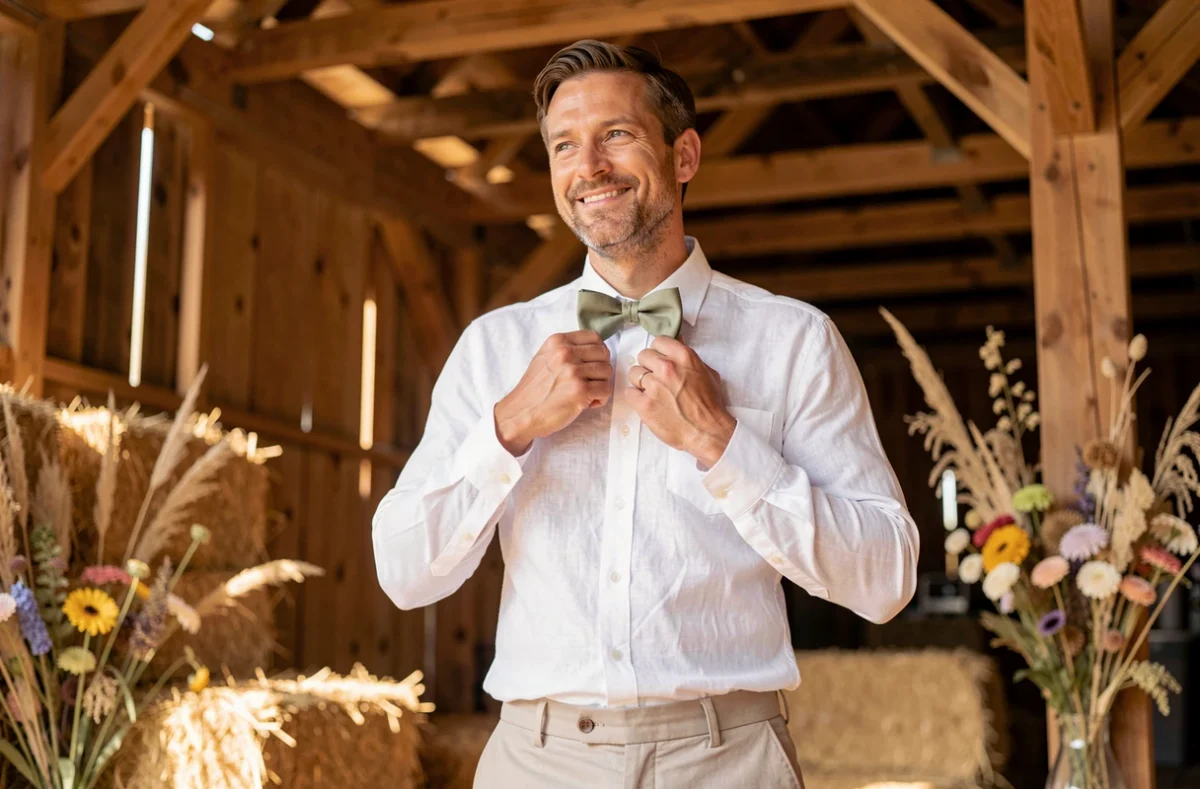
The country bow tie is not chosen like a classic ceremonial bow tie. The constraints differ: natural light, summer heat, plant decor. The material, weight, and shape of the bow determine whether the accessory fits into the setting or distorts it.
Weight and weaving: what separates a country bow tie from an urban model
A bow tie intended for an indoor wedding can tolerate heavy silk or satin. Outdoors, these materials capture light too harshly and create a visually inconsistent contrast with a linen or cotton suit.
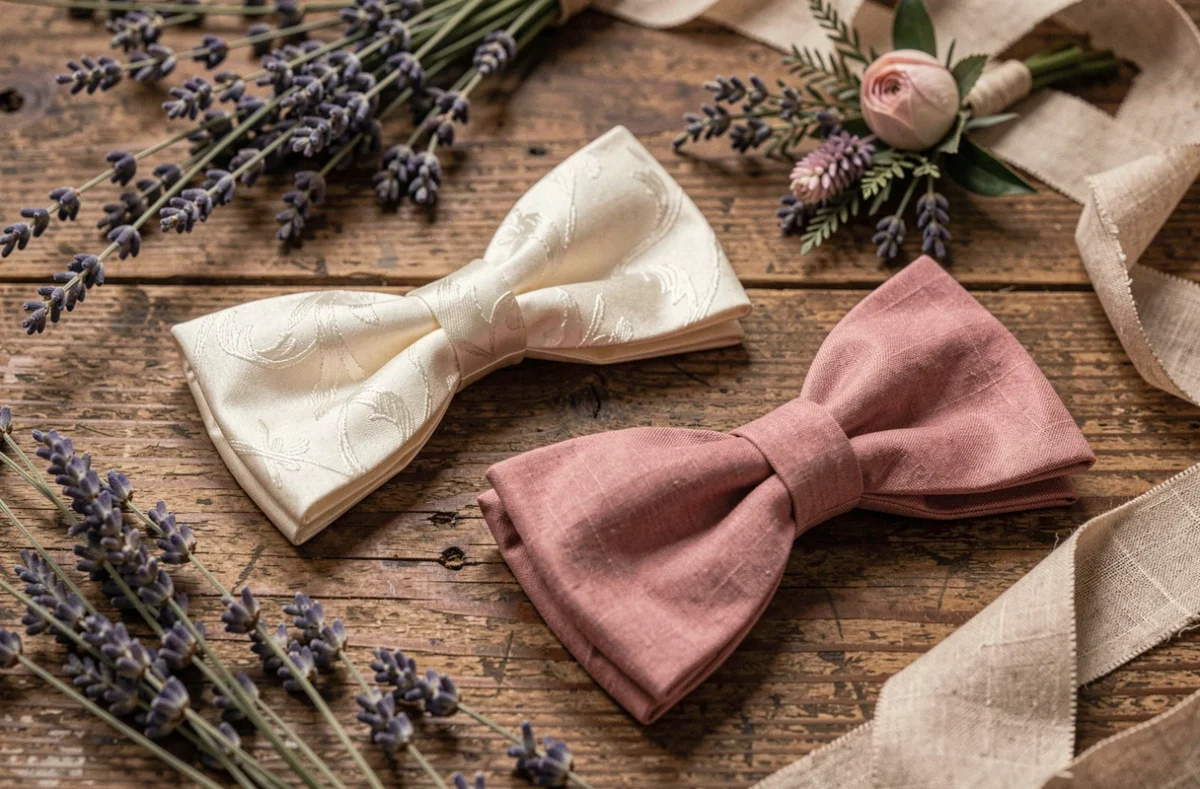
We recommend targeting matte or semi-matte weaves: linen, chambray cotton, fine wool like lightweight flannel. These fibers absorb light instead of reflecting it, maintaining harmony with the muted tones of country decor.
The weight plays a concrete role in the drape of the bow. A fabric that is too thin (cotton voile) produces a soft, asymmetrical bow after a few hours. A fabric that is too thick (tweed) makes tying difficult and the volume disproportionate on a casual shirt collar. The ideal window is in a medium weight, dense enough to hold the fold without stiffening the bow.
Twill weave, recognizable by its diagonals, offers a good compromise between flexibility and hold. Canvas weave, flatter, is suitable for printed patterns like liberty or micro-floral, common in the country setting.
Shape of the bow and type of shirt collar: the combinations that work
As detailed on the Hucky org site, the bow tie becomes the structuring element of the outfit when the suit is replaced by a vest or suspenders, a common configuration in country weddings.
The shape of the bow is not just a matter of taste. It interacts with the spacing of the shirt collar. Two shapes dominate the market:
- The pointed end bow tie (type “diamond point”): more contemporary, it works with wide Italian collars. Its reduced volume at the ends avoids the “costume” effect.
- The straight end bow tie (type “batwing”): more compact, suitable for classic French collars. Its narrow profile fits well under a buttoned vest.
- The wide end bow tie (type “butterfly”): the most voluminous. Reserved for very open cutaway collars. Risk of overwhelming a light summer outfit.
For a country wedding, the most common collar remains the slightly spread French collar. The batwing or diamond point adapts well without forcing.
Wooden bow tie: real advantages and rarely mentioned limits
The wooden bow tie has established itself in the world of country weddings due to its immediate visual character. The object attracts the eye, photographs well, and leaves a mark on the memory of the guests.
However, wood imposes technical constraints. The bow does not tie: it is a rigid piece fixed by a ribbon or textile strap. The adjustment of the neck circumference is therefore limited by the closure system, often a clip or hook. On a long day, comfort depends entirely on the quality of this attachment.
Wood does not stain uniformly across all species. Light woods (maple, birch) take laser engraving well but yellow with prolonged sun exposure. Dark woods (walnut, ebony) offer better chromatic stability.
A rarely mentioned point: compatibility with sweat. Untreated wood absorbs moisture, which can alter the fixing ribbon over time. We recommend checking that the inner face is varnished or waxed.
Color palette for a country wedding: coordinate without uniformity
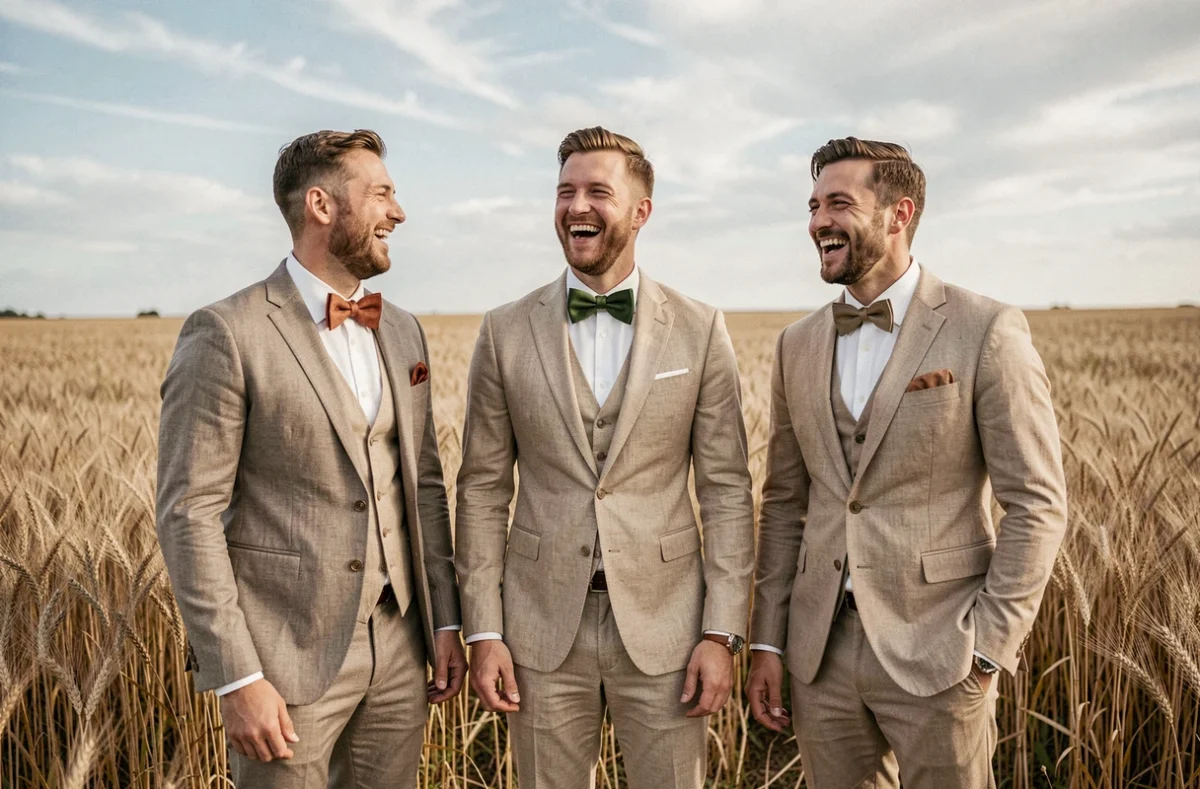
The classic mistake is to exactly match the groom’s bow tie, those of the witnesses, and the floral decoration. The result appears stiff, almost corporate. A country wedding gains authenticity when the accessories share a common color range without being identical.
The colors that integrate best with plant decor and outdoor lighting remain desaturated tones: sage green, terracotta, slate blue, muted mustard, old rose. These shades absorb the golden light of late afternoon well, the time when most group photos are taken.
For patterns, micro-patterns (subtle dots, fine stripes, small checks) photograph better than solid colors, which can appear flat in pictures. The liberty pattern remains a safe bet in the country world, provided the size of the design repeat is limited so as not to visually overwhelm a small accessory like the bow tie.
Textile composition and regulation: an emerging selection criterion
The question of composition is no longer solely about comfort. In France, textile environmental labeling is now regulated. The evaluation takes into account materials, manufacturing, transportation, maintenance, end-of-life, and microfiber release.
When the composition of a bow tie exceeds half synthetic fibers, the issue of plastic microfiber release during washing falls within the scope of communicable environmental data. A bow tie made of linen or organic cotton escapes this issue, which also simplifies its maintenance.
The claims of “ecological” or “sustainable” displayed by some wedding accessory brands can no longer rely on a simple slogan. French regulation tends to impose an official method and verifiable data. Before choosing a bow tie presented as responsible, we recommend checking that the manufacturer indicates the exact composition, the place of manufacture, and ideally, a reference to a normative framework.
The choice of a bow tie for a country wedding comes down to three concrete considerations: material suitable for outdoor light, shape compatible with the shirt collar, and color that photographs well without standardizing the party. The rest is personal style.