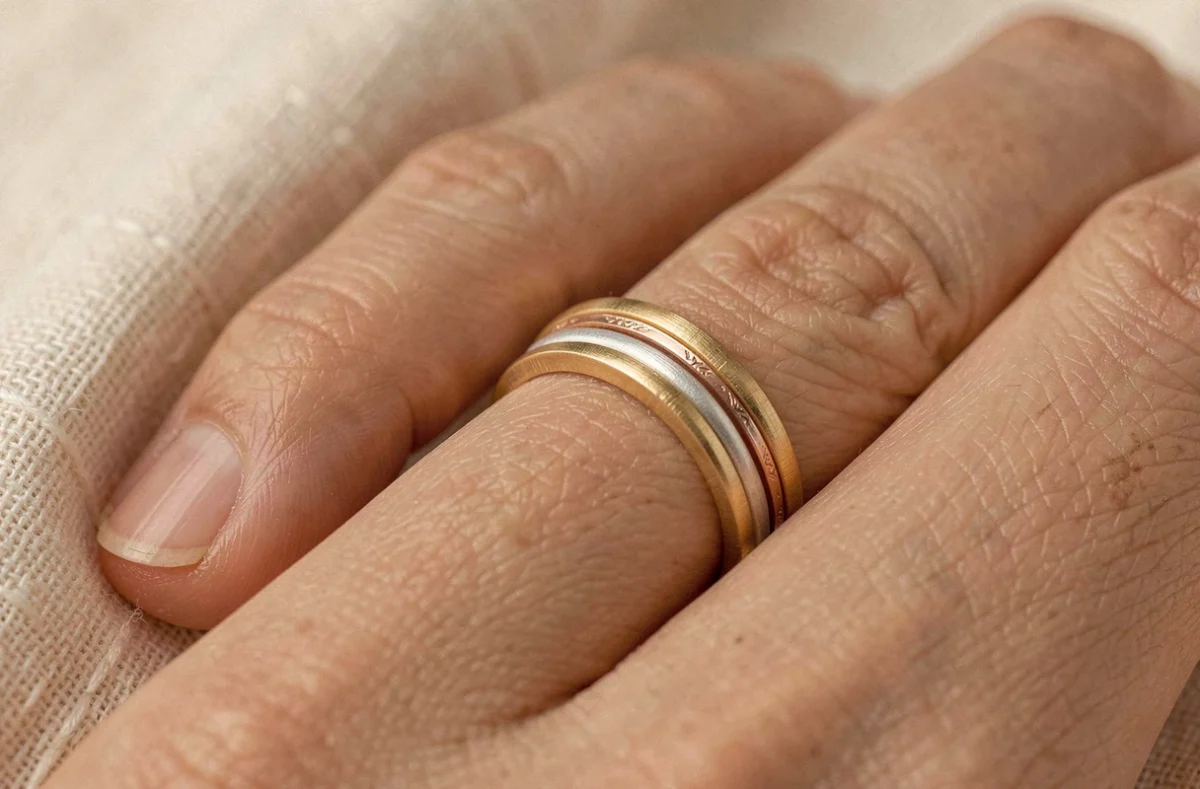
The three-interlocking-ring design relies on a precise technical mechanism: three separate ring bands that move independently of one another, held together by their interwoven geometry. This design creates manufacturing constraints that most articles on the subject overlook, preferring to focus on the romantic story. Understanding the jewelry’s physical structure makes it easier to assess its quality, authenticity, and the true significance of its symbolism.
Three-ring band: machining constraints and clearance tolerances
The three bands of an interlocking ring are not soldered together. Each band rotates freely around the other two, requiring a clearance fit accurate to a tenth of a millimeter. If the clearance is too tight, rotation is restricted and the contact surfaces develop premature scratches. If it is too loose, the ring feels flimsy and friction accelerates metal wear.
In three-gold models (yellow gold, white gold, and rose gold), each alloy has a different hardness. Rhodium-plated white gold is the hardest of the three, rose gold (alloyed with copper) offers intermediate resistance, and yellow gold is the softest. This difference means that wear is not distributed evenly across the three bands. Over time, the yellow gold band wears thinner faster than its two neighbors.
Jewelers sometimes compensate for this imbalance by slightly adjusting the thickness of each band during manufacture or applying a surface treatment to the friction points. For a pre-owned piece, examining the hallmarks and the condition of the contact surfaces (concentric scratches, localized thinning) can reveal more about its authenticity and actual age than the certificate alone.
To explore the meaning of three-ring bands beyond their technical aspects, their symbolism deserves an equally careful examination of its origins.
Three-gold symbolism: traditional interpretation or original intent?
The now-classic association—rose gold for love, yellow gold for fidelity, and white gold for friendship—is repeated today as though it were self-evident. The question rarely asked is: were these meanings intended when Cartier created the Trinity ring in 1924?

The available sources do not confirm that Louis Cartier assigned these specific meanings to the three gold colors when he first designed the ring. The story linking Jean Cocteau to the ring’s inspiration (Saturn’s rings, among other theories) is more a part of the house legend than a documented fact. The symbolism of the colors appears to have developed after the fact, reinforced by the brand’s marketing and the jewelry’s cultural adoption over the decades.
This distinction does not diminish the symbol’s power. It changes its nature: instead of a meaning encoded in the object from the outset, it becomes a collective significance, enriched by each generation of wearers. A piece of jewelry whose meaning evolves with those who choose it has a different depth from an object carrying a fixed message.
Cartier Trinity ring: authentication criteria for the pre-owned market
The Trinity’s recent centenary reignited interest in vintage models. On the secondhand market, distinguishing an authentic Trinity from a ring merely inspired by the three-band design comes down to several checks:
- The maker’s hallmarks (Cartier logo, serial number, and gold fineness mark) should be legible on each band, not just one of the three. A hallmark on only one band may indicate a replacement or a non-original piece.
- The condition of the friction points between the bands: fine, even scratches indicate normal long-term wear, while aggressive polishing can sometimes conceal significant thinning or repairs.
- How smoothly the bands rotate: a jerky movement may indicate that the circular profile has become distorted, often after an impact. Reshaping is possible, but it alters the original dimensions.
- The consistency of the three gold colors: the rhodium plating on the white gold band wears over time. Fresh rhodium plating on a model presented as vintage warrants further inspection.
A carefully inspected pre-owned ring can be just as reliable as a new one, provided you know how to read the signs of wear and distinguish routine maintenance from extensive restoration.
Three-ring wedding band: beyond the Cartier design
Cartier’s Trinity dominates the category, but interlocking three-ring bands are available in a range of styles from other jewelers. Choosing a three-ring wedding band raises practical questions that are often overlooked.

First, the jewelry’s overall width. Three interlocking bands cover more of the finger than a simple wedding band. For comfortable everyday wear, a rounded interior profile (comfort fit) is almost essential for this type of ring, otherwise it may feel uncomfortable when bending your fingers.
Next, sizing. The three moving bands do not respond to temperature changes or water retention in the same way as a single band. The ring may feel tighter in the morning and looser at the end of the day, with more noticeable variation than a classic wedding band. This should be taken into account when choosing a size.
Finally, symbolism. In a wedding context, the three bands are often reinterpreted as the couple’s past, present, and future, or as the three pillars of love, fidelity, and friendship. Others see them as a reference to the Holy Trinity in Christian traditions. The meaning remains open and personal, making this a piece of jewelry that each couple can imbue with their own story, without outside prescriptions.
The three-ring band owes its longevity to this dual nature: it is a technically demanding object whose manufacture requires real precision, and a symbolic canvas open enough to accommodate multiple interpretations. It is precisely because its meaning was never fixed from the outset that it continues to evolve, carried by those who choose it.