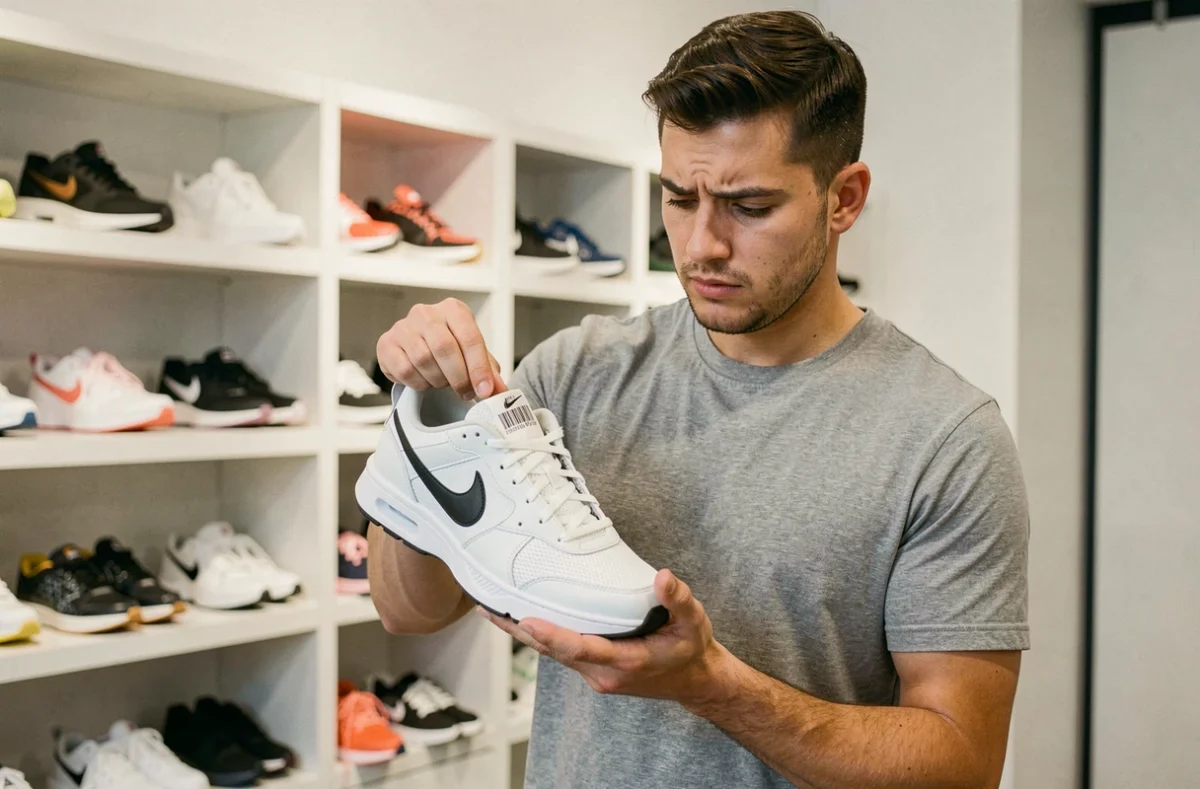
The UPC code printed on the label of a pair of Nikes is often presented as a safeguard against counterfeiting. Scanning this barcode with an app, getting a result that points to a real model, and concluding that the pair is authentic: this sequence is reassuring, but it relies on a partial understanding of what the UPC code actually contains, and especially what it does not contain.
Nike UPC Code: What the Bars Really Encode
A UPC-A code (twelve digits) or its international equivalent EAN-13 (thirteen digits) primarily serves to identify a product in a distribution chain. It associates a manufacturer prefix with an item reference. For Nike, this designates a specific model, colorway, and size.
What this code does not contain is more revealing: no lot data, no manufacturing date, nor individual traceability. GS1 specifications clearly distinguish the GTIN (product identifier) from serialization data that would allow tracing back to a specific pair. A UPC code is therefore a generic identifier, shared by all units of the same item.
This architecture has a direct consequence: a counterfeiter can copy an authentic UPC code and print it on a fake pair. The scan will return to the correct Nike product page, without proving anything about the physical object you are holding. This is precisely why it is essential to verify the Nike UPC code before buying by cross-referencing this information with other checkpoints.
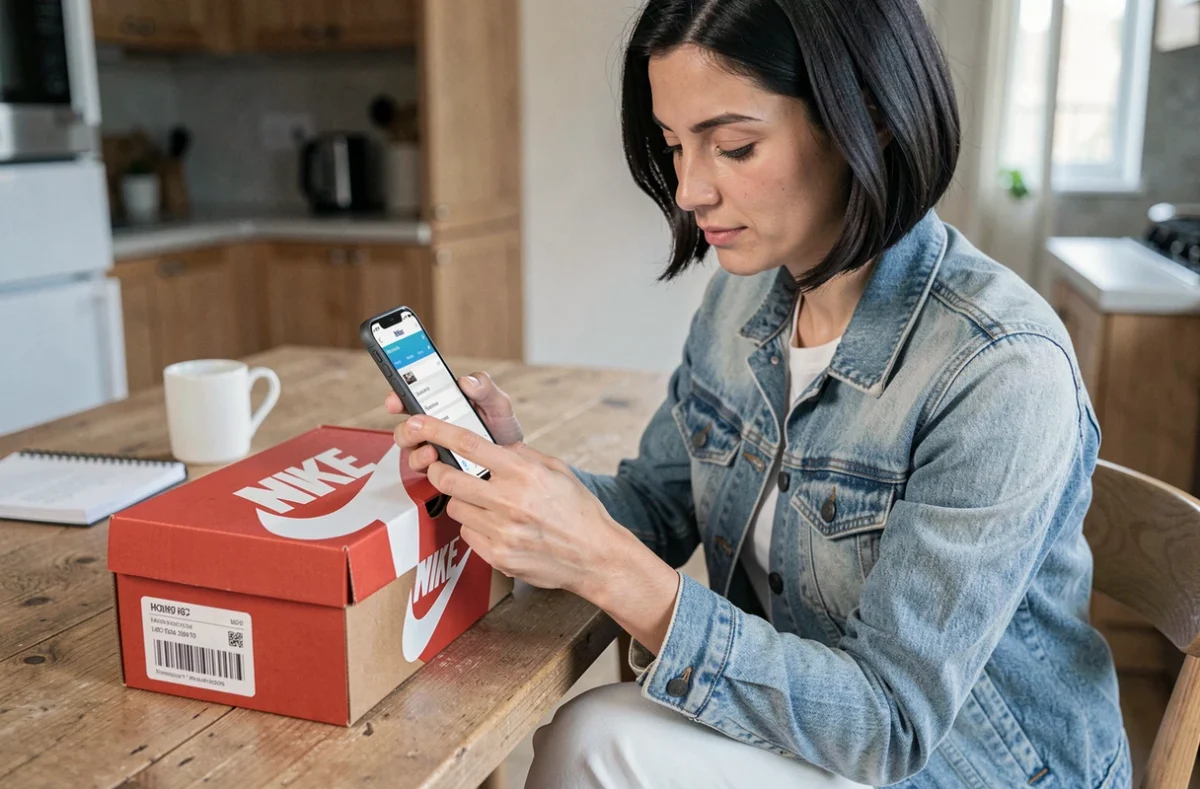
Consistency Between Label, Box, and Shoe: The True Test of Nike Authenticity
Recent control guides emphasize a principle more reliable than simple scanning: consistency verification. The idea is to compare the information present on three distinct supports: the inner label of the shoe, the side label of the box, and the pair itself.
The elements to cross-reference form a bundle of clues:
- The product code (style code) must be identical on the inner label and on the box, with no variation in numbers or letters.
- The indicated size must match on both supports and the actual shoe size. A discrepancy between the printed size and the physical size is a common warning signal.
- The colorway mentioned on the label must correspond to the visible colorway of the pair. A code associated with a colorway different from what you observe indicates either a pairing error or a counterfeit.
The same UPC code associated with a different colorway or size is a clear warning signal. This type of inconsistency goes unnoticed if you only scan the barcode without inspecting the printed details around it.
Points of Caution on the Inner Label
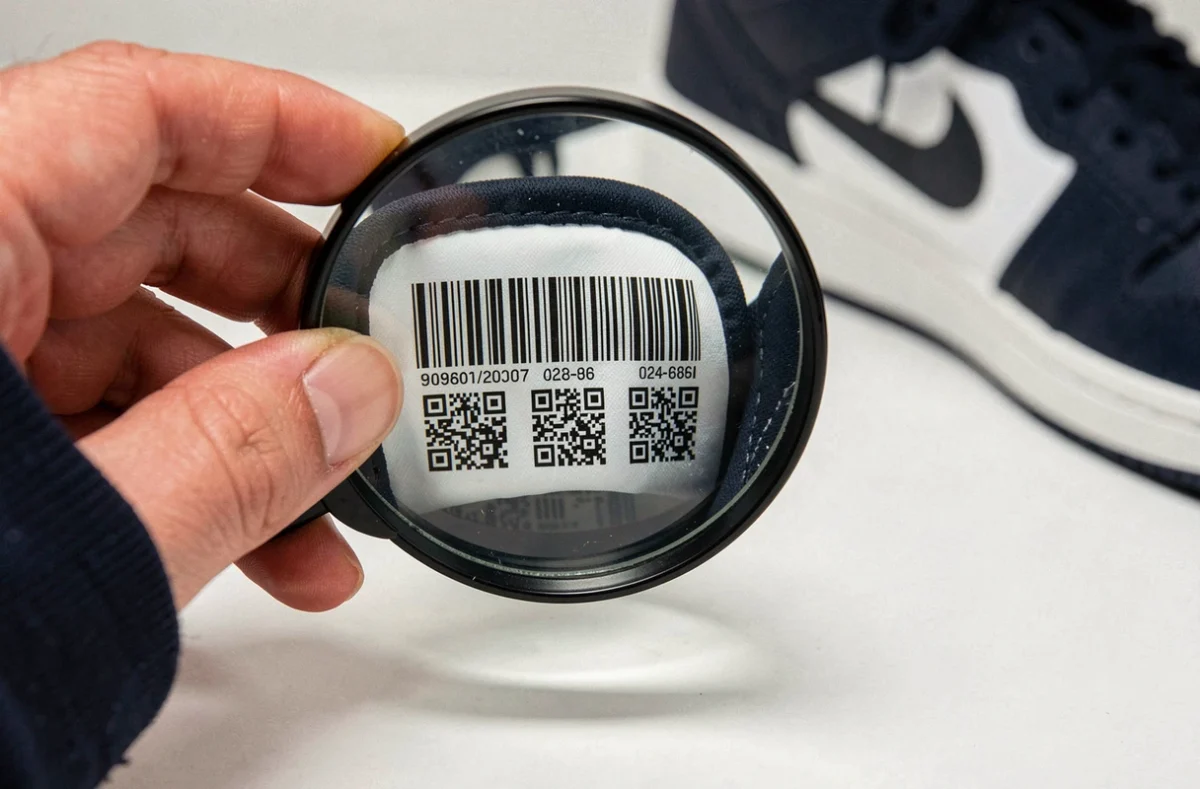
The label sewn inside the shoe generally contains the country of manufacture, the model number, the size in several systems (US, UK, EUR, CM), and the barcode. On an authentic pair, the font is sharp, the spacing is regular, and the alignment of the lines is consistent.
Recent counterfeits reproduce these labels with an increasing level of detail. However, discrepancies often remain in the spacing between characters, the thickness of the textile support, or the print quality of the barcode itself. A barcode with blurry bars or irregular thickness will not scan correctly with certain applications, which can reveal a lower quality print.
Limitations of UPC Scanning and False Sense of Security
The reflex to scan a barcode before buying a pair on a resale market has spread. Several apps allow you to instantly obtain the product name, its suggested retail price, and sometimes an image of the model. This positive result creates a sense of validation that can be misleading.
The presence of a code linking to a real product page does not validate the pair. Counterfeiters retrieve codes from authentic shoes, from photos of labels shared online, or from the product listings themselves. The code is then printed on the label of the copy. The scan works, the result is correct, but the pair is not.
This limitation is rarely mentioned in guides that present UPC scanning as a verification method. The available data does not allow quantifying the proportion of counterfeits that pass this test, but the mechanism is documented and known to professional authentication platforms.
Proof of Purchase and Seller Reliability: Underestimated Criteria
The technical verification of the pair (codes, labels, finishes) only covers part of the risk. The other part concerns the purchase channel itself.
An original invoice, a receipt from an official store, or an order confirmation from the Nike website are elements of traceability that the UPC code alone cannot replace. The risk of counterfeiting varies significantly depending on the sales channel. Peer-to-peer resale platforms, social media groups, and sites offering prices well below the suggested retail price concentrate the majority of reported cases.
Some resale platforms now integrate authentication services before shipping, with physical inspection of the pair by a third party. This type of verification remains more reliable than a barcode scan performed by the buyer, because it combines visual examination, code checks, and comparison with internal databases.
Complementary Technologies: QR Codes and NFC Chips
Nike is gradually integrating QR codes and NFC chips into certain models. These technologies add a layer of verification that the UPC code does not provide: the NFC chip, physically embedded in the shoe, is more difficult to reproduce than a printed barcode. Field returns vary on the reliability of these systems depending on the models and distribution regions, but they represent an evolution from the traditional barcode.
The UPC code remains a useful tool as long as it is not assigned a function it does not have. It identifies a product in a catalog. It does not certify the authenticity of a physical object. Cross-referencing it with visual inspection, label consistency, proof of purchase, and seller reputation forms a much more robust set of verifications than an isolated scan.