
A family garden that works relies less on the equipment catalog than on the initial zoning and choice of materials. Here we address the technical points that most general public guides skim over, from the sizing of play areas to the design of scalable modules suitable for various age groups.
Substrates and flooring for garden play areas
The choice of flooring under a play structure determines the safety and longevity of the installation. Natural grass wears out in a few weeks under a frequently used swing set, revealing slippery bare earth in wet weather.
We recommend distinguishing three types of surfaces based on use. Under swings and slides, a bed of untreated wood chips (minimum thickness of the critical fall height divided by five) absorbs impacts while remaining permeable.
For running and biking areas, a drained synthetic grass on a compacted sand bed offers a tear resistance that natural grass cannot provide. For a sand corner dedicated to the little ones, washed sand with controlled grain size limits the risk of ingestion of fine particles.
A common mistake is to lay decorative gravel under a swing set. Round gravel can be thrown, while angular gravel can cause injuries. Recycled rubber shock-absorbing tiles are a reliable technical alternative, but their cost and industrial appearance often deter families. The most common compromise in family landscaping remains wood chips, replaced each spring. Specialized resources like those available at jardindivert.com help identify supplies suitable for each terrain configuration.
Zoning the family garden: dividing the space by function

A playful garden for children is not improvised by randomly scattering equipment. Functional zoning prevents conflicts between adult relaxation and free play. We systematically divide into three to four zones, even on modest surfaces.
- Active zone (swing set, sunken trampoline, climbing wall): positioned at the back of the yard, away from large windows and fragile flower beds, with a peripheral clearance of at least two meters around each structure
- Calm zone (wooden playhouse, reading nook, hammock): backed by a hedge or a plant screen to create a retreat effect, with a stable surface such as wooden decking or tiles laid on a sand bed
- Mixed zone (family vegetable garden, water play area, gardening table): placed halfway between the terrace and the active zone, accessible to both adults and children, oriented to capture the best sunlight
- Buffer zone (low hedge, planted border, slope): physically separates the active zone from the vegetable garden or flower beds, limiting lost balls in the crops
This division works even on relatively small garden areas. The trick is to use changes in level or flooring to visually mark the boundaries between zones, rather than rigid fences.
Scalable play structures: designing for multiple ages of children
Family landscapers are noticing a growing preference for modular gardens that evolve with children’s ages, according to a survey conducted by the French Federation of Landscape among 500 families. Removable structures reduce long-term renovation costs and prevent the garden from being fixed around a slide that becomes useless at age ten.
The principle: start with a treated wood frame on which interchangeable modules are fixed. At three years old, a covered sandpit and a small slide are attached. At six years old, the sandpit is replaced by a low climbing wall. At ten years old, the wall increases in height and a lateral climbing net is added.
Wood remains the reference material for these DIY family structures. Class 4 treated pine withstands soil moisture without additional treatment. Black locust, naturally rot-resistant, represents a high-end choice that requires neither stain nor saturator. All fasteners must be at least A2 stainless steel to avoid corrosion and injuries from protruding rusty screws.
Sensory garden and biodiversity: a concrete learning ground
The integration of biodiversity modules in playful gardens has significantly developed in recent years. Insect hotels, interactive composting areas, and tactile aromatic plant squares transform the play space into an educational support, according to observations from the National Union of Landscape Enterprises.
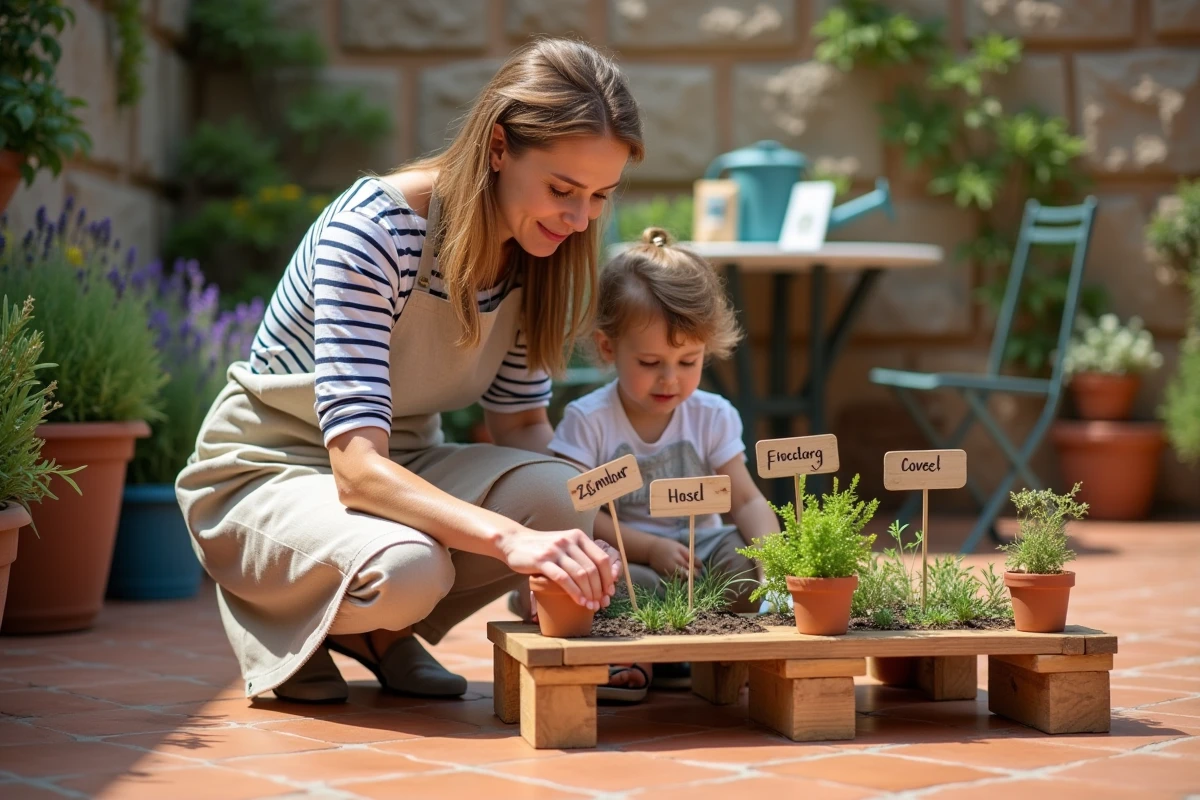
One angle that is still underutilized concerns the hybridization between playful gardens and sensory elements for therapeutic purposes. Aromatic plants such as lavender, mint, and thyme, placed at child-height in raised beds, stimulate touch and smell. The French Association of Ambulatory Pediatrics highlights the benefits of these setups for neurodivergent children.
In terms of implementation, we prefer a linear sensory path along an existing walkway rather than a dedicated isolated space. An alignment of five to six wooden beds, each containing a plant with different textures and scents (woolly sage, rigid rosemary, soft basil), creates a route that children naturally take as they move between the garden areas.
An insect hotel placed near the family vegetable garden serves a dual purpose: observing beneficial wildlife and pollinating crops. Children concretely follow the link between the solitary bee they observe in the morning and the zucchini they harvest a few weeks later.
A well-zoned family garden, built on modular structures and enriched with a sensory path, remains functional well beyond early childhood. The play area for a three-year-old becomes the botanical laboratory for a pre-teen, without heavy earthworks or complete equipment replacement.